Blog
RamayanaTrailSriLanka
9/15/2026 · 5 min read
Ramayana Trail Sri Lanka
9/15/2026•5 min read•Blog
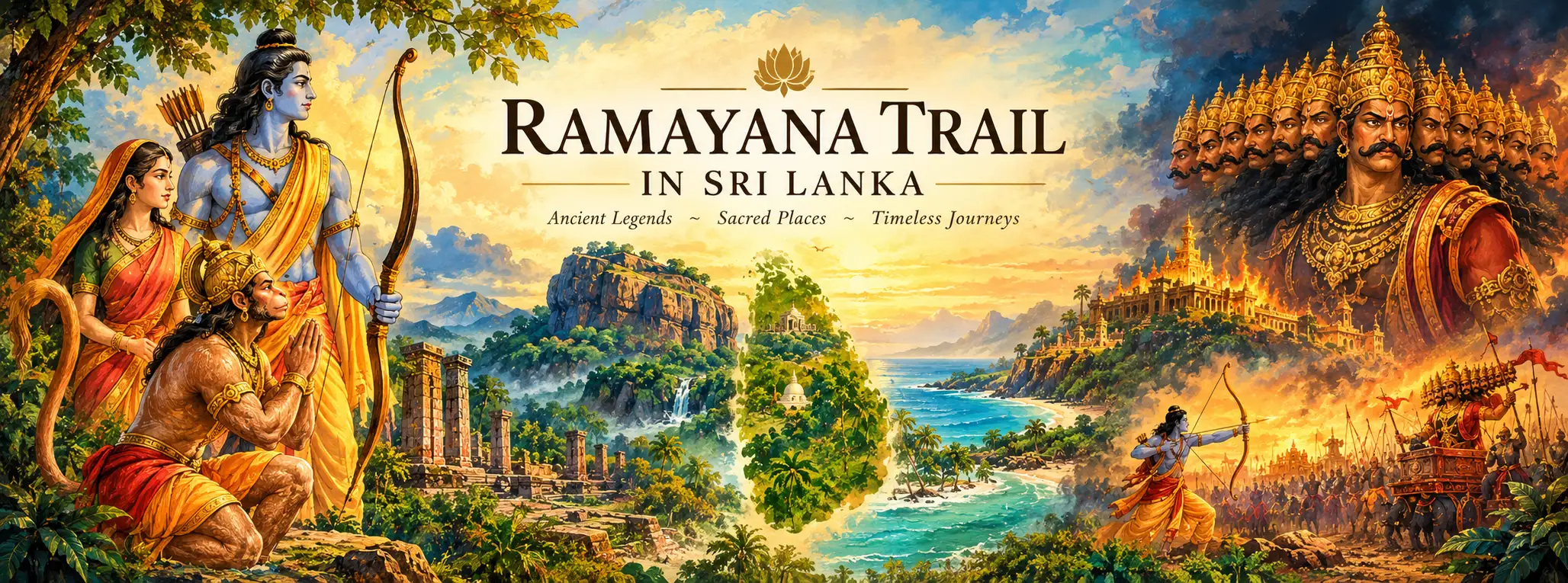
The Ramayana Trail in Sri Lanka: Follow the Epic Journey of Rama, Sita, Hanuman and Ravana
From the sacred temples of Chilaw and Trincomalee to the misty mountains of Nuwara Eliya, the caves of Ella and the legendary landscapes of the southern coast, Sri Lanka offers a remarkable journey through places associated with the Ramayana epic.
Imagine following the footsteps of Lord Rama, Sita Devi, Lord Hanuman and King Ravana through a tropical island of mist-covered mountains, ancient forests, waterfalls, temples, caves and golden beaches.
This is the Ramayana Trail of Sri Lanka — a journey where mythology, spirituality, nature and living culture come together.
For centuries, the Ramayana has travelled across South Asia and beyond. In Sri Lanka, numerous places are traditionally associated with episodes from the epic, creating a fascinating pilgrimage and cultural route for visitors from India, the United Arab Emirates, Europe and around the world.
Sri Lanka Tourism's official Ramayanaya Yathra programme identifies more than 50 locations associated with the Ramayana tradition, opening the possibility of experiencing the epic not simply as a story, but as a journey through real landscapes and living places.
A Journey Where the Ramayana Comes Alive
The Ramayana tells the story of Rama, Sita, their exile, Sita's abduction by Ravana, Hanuman's search for Sita, the great battle in Lanka and Rama's eventual return.
Sri Lanka's Ramayana Trail follows many locations that local traditions connect with these chapters.
Some locations are ancient temples and pilgrimage sites. Others are caves, waterfalls, forests, mountains and unusual geological landscapes.
The experience becomes especially powerful when travellers move through the island's changing scenery:
Chilaw → Sigiriya → Trincomalee → Kandy → Nuwara Eliya → Ella → Kataragama → Ussangoda → Galle → Mannar
Each region adds another chapter to the journey.
Chapter 1 – Rama's Journey Begins in Lanka
Manavari Kovil – Chilaw
One of the most important early stops on the Ramayana Trail is Manavari Kovil, near Chilaw.
According to the tradition, after defeating Ravana, Lord Rama installed a Shiva Lingam here and prayed to Shiva.
The lingam is known as Ramalingam, and the site holds special significance for devotees following the Ramayana pilgrimage.
Sri Lanka Tourism identifies Manavari as the first place in Lanka where Rama is traditionally believed to have installed a Shiva Lingam after the war.
Nearby experiences
Munneswaram Kovil
Chilaw
Fishing villages
Coastal landscapes
Local Hindu temples
For Indian pilgrims, Manavari can be an especially meaningful beginning to a Sri Lankan Ramayana journey.
Chapter 2 – Munneswaram: Rama's Prayer After the War
Munneswaram Kovil – Chilaw
The ancient Munneswaram Temple is another major spiritual stop.
According to Ramayana tradition, Rama stopped here after defeating Ravana because he felt the spiritual consequences of having killed Ravana, who was regarded as a Brahmin.
The tradition says that Rama prayed to Lord Shiva for relief from this spiritual burden.
Sri Lanka Tourism describes the legend of Rama stopping at Munneswaram and being advised to install Shiva Lingams at several sacred locations, including Manavari, Thirukoneswaram and Thiruketheeswaram.
The temple therefore connects the story of the war with a deeper theme found throughout the Ramayana tradition:
victory, responsibility, devotion and redemption.
Chapter 3 – Sigiriya: The Mysterious Lanka of Ravana
Sigiriya Rock Fortress
Few places in Sri Lanka create a stronger sense of mystery than Sigiriya.
Rising dramatically from the surrounding forests, the ancient rock fortress is one of Sri Lanka's most famous UNESCO World Heritage Sites.
Within Ramayana traditions, Sigiriya and surrounding caves have sometimes been connected with Ravana's Lanka and places associated with Sita's captivity.
The historical archaeological story of Sigiriya belongs to a much later period than the Ramayana, so visitors should understand the Ramayana connection as legend and cultural tradition rather than established archaeological fact.
But this is precisely what makes the experience fascinating.
Standing beneath the enormous rock, surrounded by jungle and ancient ruins, it is easy to understand why generations of storytellers have associated the dramatic landscape with the legendary kingdom of Lanka.
Nearby attractions
Pidurangala Rock
Hiriwadunna village
Minneriya National Park
Kaudulla National Park
Dambulla Cave Temple
Traditional village experiences
Chapter 4 – Trincomalee: Ravana's Devotion to Shiva
Thirukoneswaram Kovil
Perched dramatically above the Indian Ocean at Swami Rock in Trincomalee, Thirukoneswaram Kovil is one of the most spectacular temples on the Ramayana Trail.
The temple is strongly associated with Ravana's devotion to Lord Shiva.
According to tradition, Sage Agastya built the temple following the instructions of Lord Shiva, who was pleased with Ravana's devotion.
The tradition also connects Rama with the temple, saying that he prayed here after the war.
Sri Lanka Tourism identifies Thirukoneswaram as one of the important Ramayana sites associated with both Ravana's devotion and Rama's prayers.
Today, the location offers something beyond mythology:
a spectacular combination of Hindu spirituality, dramatic cliffs and the blue waters of the Indian Ocean.
Nearby attractions
Uppuveli Beach
Nilaveli Beach
Pigeon Island National Park
Kanniya Hot Springs
Trincomalee harbour
Chapter 5 – Kanniya Hot Springs
Kanniya Hot Water Springs – Trincomalee
The Kanniya Hot Water Springs are associated with a fascinating Ravana legend.
Local tradition says that Ravana created the hot springs following the death of his mother.
The site consists of several warm-water wells and has long been associated with pilgrimage and local religious traditions.
For travellers, Kanniya offers a peaceful combination of mythology, culture and natural heritage.
After visiting Thirukoneswaram, travellers can continue to the hot springs before relaxing along the beaches of Trincomalee.
Chapter 6 – Sita's Captivity
Sita Kotuwa – Hasalaka
Deep in the forested landscape around Hasalaka lies Sita Kotuwa, traditionally associated with the early period of Sita's captivity.
According to the local Ramayana tradition, this was once part of Ravana's kingdom, where Sita was kept before being taken to Ashok Vatika.
Sri Lanka Tourism describes Sita Kotuwa as an archaeological site traditionally connected with Sita's stay in the area and the ancient city of Lankapura.
The journey to Sita Kotuwa is part of the attraction.
Visitors leave the main road and enter a quieter landscape of forest, streams and hills — an experience very different from conventional sightseeing.
Chapter 7 – Hanuman Searches for Sita
Ramboda and Sri Bhakta Hanuman Temple
The mountains of Ramboda are among the most atmospheric locations on the Ramayana Trail.
According to tradition, Hanuman searched these hills for Sita.
The Sri Bhakta Hanuman Temple, established by the Chinmaya Mission, has become an important pilgrimage stop for devotees.
Sri Lanka Tourism specifically identifies the Ramboda hills with Hanuman's search for Sita.
The temple is surrounded by spectacular mountain scenery, tea plantations and waterfalls.
Nearby attractions
Ramboda Falls
Tea plantations
Tea factories
Pussellawa
Mountain villages
This is where the Ramayana Trail begins to transform into a journey through Sri Lanka's famous central highlands.
Chapter 8 – Thotupola Kanda: The World of Ravana's Vimana
Thotupola Kanda – Horton Plains
High in Sri Lanka's central mountains lies Thotupola Kanda, one of the locations traditionally associated with Ravana's aircraft.
Ramayana traditions in Sri Lanka connect several locations with Ravana's Vimana, including Thotupola Kanda.
The official Sri Lanka Tourism Ramayanaya material lists Thotupola Kanda among the locations associated with Ravana's legendary aircraft.
Today, the attraction is not only the legend.
It is also the landscape.
Highland forests, mist, grasslands and dramatic mountain scenery make this a memorable experience for travellers who enjoy hiking and nature.
Chapter 9 – Ashok Vatika: Where Sita Waited for Rama
Sita Amman Kovil & Hakgala Botanical Garden – Nuwara Eliya
For many pilgrims, Sita Amman Kovil is the emotional heart of the Ramayana Trail.
The temple is traditionally associated with the place where Sita lived during her captivity.
According to the tradition, Sita prayed continuously for Rama while refusing Ravana's advances.
A stream flows beside the temple, and rocks near the water are traditionally associated with the footprints of Hanuman.
Sri Lanka Tourism describes Sita Amman Temple at Seetha Eliya as a major Ramayana site and notes the traditional association with Sita's bathing place and Hanuman's footprints.
Just a short distance away is Hakgala Botanical Garden, traditionally associated with Ashok Vatika / Ashokavanam.
The landscape of flowering plants, enormous trees and mist-covered mountains creates an atmosphere that makes this one of the most beautiful sections of the journey.
Nearby attractions
Hakgala Botanical Garden
Hakgala Ella
Moon Plains
Gregory Lake
Nuwara Eliya town
Tea plantations
Chapter 10 – Divurumpola: Sita's Agni Pariksha
Divurumpola Temple – Welimada
The journey continues towards Divurumpola, traditionally identified with the place where Sita underwent the Agni Pariksha after the war.
The story represents one of the most dramatic and controversial episodes of the Ramayana.
Today, Divurumpola remains a respected religious site, and local traditions connect the temple with truth, fidelity and the taking of oaths.
Sri Lanka Tourism's Ramayana material also identifies Divurumpola with Sita's Agni Pariksha.
Chapter 11 – Ravana's Cave and the Mysteries of Ella
Ravana Cave – Ella
The mountains surrounding Ella are filled with stories.
One of the best known is Ravana Cave, traditionally associated with Ravana's captivity of Sita.
The cave is reached by a climb through the mountains, creating an adventurous element within the pilgrimage.
Sri Lanka Tourism describes the cave and its surrounding tunnel traditions as part of the Ramayana landscape.
Explore Ella
A Ramayana tour can also combine mythology with some of Sri Lanka's most famous natural attractions:
Ravana Falls
Ella Rock
Little Adam's Peak
Nine Arch Bridge
Tea plantations
Mountain viewpoints
This combination makes Ella particularly attractive to younger Indian travellers, couples, families and international adventure travellers.
Chapter 12 – Nil Diya Pokuna: The Underground Mystery
Nil Diya Pokuna – Ella
Hidden beneath the mountains is Nil Diya Pokuna, an underground water pool traditionally associated with Ravana and Sita.
The journey to the site involves navigating challenging terrain, adding an adventurous dimension to the Ramayana experience.
For travellers who want something beyond temples, this is an opportunity to explore the mysterious underground landscapes of Sri Lanka.
Chapter 13 – Dunuwila: The Arrow of Rama
Dunuwila Lake – Matale
The story reaches its dramatic climax at Dunuwila.
According to local Ramayana tradition, this is the place from which Rama fired the powerful Brahmastra towards Ravana.
The name itself is connected with this story:
Dhunu = arrow
Vila = lake
Sri Lanka Tourism also records the tradition that Rama fired the Brahmastra from Dunuvila and that the name is associated with the arrow and lake.
The surrounding landscape of forests, mountains and rural Sri Lanka makes this a fascinating stop for travellers following the final battle narrative.
Chapter 14 – Kataragama: Divine Protection
Ruhunu Maha Kataragama Dewalaya
The journey then moves south to Kataragama, one of Sri Lanka's most important pilgrimage destinations.
The temple is associated with Lord Karthikeya / Skanda, and Ramayana tradition says that he came to the battlefield to protect Rama from Ravana's powerful Brahmastra.
Sri Lanka Tourism's Ramayana material records this tradition and identifies Kataragama as an important location connected with the final battle.
Today, Kataragama is much more than a Ramayana destination.
It is a living pilgrimage centre visited by people of different faiths and traditions.
Nearby attractions
Kiri Vehera
Sella Kataragama
Yala National Park
Kataragama village
Local pilgrimage ceremonies
Chapter 15 – Ussangoda: Ravana's Legendary Landing Ground
Ussangoda – Southern Sri Lanka
Along Sri Lanka's southern coast lies the unusual landscape of Ussangoda.
According to Ramayana tradition, the location was associated with Ravana's legendary aircraft and is also connected with the story of Hanuman setting parts of Lanka on fire.
The official Sri Lanka Tourism Ramayanaya site records the tradition that Ussangoda was one of Ravana's aircraft landing areas and one of the places affected by the burning of Lanka.
Today, Ussangoda is protected as a natural area with an unusual landscape overlooking the ocean.
It is a spectacular place to experience the contrast between mythology and Sri Lanka's wild southern coastline.
Chapter 16 – Rumassala: Hanuman Brings the Mountain
Rumassala – Galle
One of the most memorable stories of Hanuman's devotion comes alive at Rumassala near Galle.
During the great battle, Rama and Lakshmana were badly injured.
Hanuman was sent to find a life-saving herb from the Himalayas.
Unable to identify the correct plant, Hanuman is said to have lifted an entire section of the mountain and carried it back.
According to Sri Lankan tradition, pieces of that mountain fell in several places around the island, including Rumassala, Dolu Kanda, Ritigala, Thalladi and Kachchativu.
Rumassala is now known for its rich vegetation and beautiful coastal setting.
Nearby attractions
Galle Fort
Unawatuna
Jungle Beach
Rumassala Beach
Indian Ocean viewpoints
This is an ideal location to combine a Ramayana pilgrimage with a relaxing southern Sri Lankan beach holiday.
Chapter 17 – Kelaniya: The Kingdom of Vibhishana
Kelaniya Temple – Colombo
The Ramayana story does not end with Ravana's defeat.
After the war, Vibhishana, Ravana's brother who supported Rama, is traditionally believed to have become the ruler of Lanka.
Kelaniya is associated with Vibhishana's worship and remains an important cultural and religious site.
The location also has profound significance in Sri Lankan Buddhist tradition.
This makes Kelaniya an excellent final cultural experience for travellers who want to understand how different religious traditions have shaped Sri Lanka.
Chapter 18 – Rama Setu and the Northern Connection
Adam's Bridge / Rama Setu – Mannar
The northern end of Sri Lanka brings travellers to one of the most fascinating geographical features connected with the Ramayana:
Adam's Bridge, also known as Rama Setu.
The chain of limestone shoals stretches between the Mannar area of Sri Lanka and Rameswaram in Tamil Nadu, India.
According to the Ramayana, Rama's army of Vanaras constructed a bridge across the sea to reach Lanka.
Sri Lanka Tourism describes the geological formation as a chain of limestone shoals between India and Sri Lanka while also recording its association with the Ramayana's Setubandhanam.
For Indian travellers, this creates a particularly powerful connection:
India and Sri Lanka become two landscapes within one extraordinary epic journey.
Explore Mannar
Talaimannar
Mannar Fort
Talaimannar Pier
Old Lighthouse
Giant Baobab Tree
Thiruketheeswaram Kovil
Madhu Shrine
A Ramayana Journey Is More Than a Pilgrimage
The greatest attraction of the Ramayana Trail is that it combines several types of travel in one journey.
Spiritual Travel
Visit temples dedicated to Rama, Sita, Hanuman, Shiva, Skanda and Vibhishana.
Cultural Travel
Experience Sri Lankan Hindu traditions, Buddhist heritage, village life and local customs.
Nature & Eco-Tourism
Walk through forests, mountains, waterfalls, botanical gardens and protected landscapes.
Adventure
Explore caves, hiking trails, mountain viewpoints and hidden natural sites.
Beach Holidays
Relax on the beaches of Trincomalee, Mannar, Galle and Sri Lanka's southern coast.
Family Travel
The Ramayana is a story that can be experienced across generations, making the trail particularly suitable for families travelling from India and the Indian diaspora.
Why Choose a Ramayana Tour in Sri Lanka?
For travellers from India, Sri Lanka offers the opportunity to extend the Ramayana pilgrimage beyond the Indian mainland and experience the landscapes traditionally associated with the Lanka chapter of the epic.
For the Indian diaspora in Dubai and the UAE, a Sri Lankan Ramayana journey offers a convenient combination of spirituality, culture, luxury accommodation, nature and family travel.
For European travellers, the Ramayana Trail offers something different from a conventional Sri Lankan holiday — a journey combining mythology, archaeology, Hindu spirituality, tropical nature and living cultural traditions.
And for everyone, there is one unforgettable element:
the landscapes themselves.
Misty mountains.
Ancient temples.
Jungle-covered caves.
Sacred streams.
Waterfalls.
Tropical forests.
Golden beaches.
And the Indian Ocean separating two lands connected by one of the world's greatest epics.
Experience the Ramayana Trail with Tranquil Sri Lanka Tours
A Ramayana tour should not feel like a checklist of temples.
It should feel like a story unfolding day by day.
At Tranquil Sri Lanka Tours, we can design private and customised Ramayana journeys around the interests of each traveller — whether you are travelling as a family, couple, group of devotees, cultural traveller or luxury pilgrimage group.
Your journey can combine the major Ramayana sites with Sri Lanka's:
Tea country
Waterfalls
Wildlife safaris
Beaches
UNESCO World Heritage Sites
Hindu temples
Buddhist heritage
Local villages
Scenic train journeys
Traditional Sri Lankan cuisine
Boutique hotels and nature stays
Rather than simply visiting a temple and leaving, we can connect each location with the Ramayana story, explaining the traditional beliefs and legends as you travel through the island.
Follow the Story. Discover Sri Lanka.
The Ramayana has survived for thousands of years because it is more than a story of war.
It is a story of love, loyalty, courage, devotion, sacrifice, responsibility and the struggle between good and evil.
Sri Lanka adds another dimension to that story.
Here, the legendary Lanka of the Ramayana is imagined among mountains, forests, waterfalls, temples and oceans.
Whether you come as a devotee from India, a family from Dubai, an international traveller from Europe or simply someone fascinated by ancient epics, the Ramayana Trail in Sri Lanka offers a journey unlike any ordinary holiday.
Come to Sri Lanka.
Follow the trail of Rama.
Walk through the landscapes of Sita.
Discover the devotion of Hanuman.
Explore the legendary Lanka of Ravana.
And experience the Ramayana in the island where the final chapters of the epic are traditionally believed to have unfolded.
Begin your Ramayana journey with Tranquil Sri Lanka Tours.
Ramayana Trail Sri Lanka | Ramayana Tour Sri Lanka | Rama Sita Hanuman Tour | Ravana Trail Sri Lanka | Hindu Pilgrimage Sri Lanka | Ramayana Yatra | Sri Lanka Spiritual Tour | India to Sri Lanka Ramayana Tour