Blog
KandyEsalaPerahera2027|SriLanka'sGrandFestival&TravelGuide
9/21/2026 · 5 min read
Kandy Esala Perahera 2027 | Sri Lanka's Grand Festival & Travel Guide
9/21/2026•5 min read•Blog
andy Esala Perahera: Sri Lanka’s Grand Festival of Culture, Faith and Tradition
Kandy Esala Perahera is one of the most spectacular cultural and religious festivals in Sri Lanka and one of the most important annual events in Kandy, the historic hill capital of the island.
Held during the Esala full-moon period, usually in July or August, the festival brings together sacred traditions, Kandyan drummers and dancers, decorated elephants, traditional craftsmen, torch bearers and thousands of devotees and visitors. The annual celebration culminates in a series of magnificent night processions through the streets of Kandy.
For travellers planning a Sri Lanka holiday, Kandy tour or cultural tour of Sri Lanka, experiencing the Perahera can be one of the most memorable ways to discover the country's living heritage.
What Is the Kandy Esala Perahera?
The Kandy Esala Perahera, also known as the Sri Dalada Perahera, is a historic procession centred on the Sacred Tooth Relic of the Buddha, which is enshrined at the Temple of the Sacred Tooth Relic in Kandy.
The festival combines the procession of the Dalada Maligawa with processions associated with four historic devales, or shrines, dedicated to Natha, Vishnu, Kataragama and Pattini. Sri Lanka Tourism describes these as five interconnected Peraheras, with the Dalada Maligawa procession taking precedence.
The festival is not simply a colourful parade for tourists. It remains an important religious and cultural observance for Sri Lankan Buddhists and communities connected with the historic traditions of Kandy.
A Festival More Than a Thousand Years in the Making
The history associated with the Sacred Tooth Relic goes back to the 4th century CE, when the relic was brought to Sri Lanka during the reign of King Kithsiri Mewan (Kirthisiri Meghawanna).
According to the traditional historical account, Prince Danta and Princess Hemamala brought the Sacred Tooth Relic from India to Sri Lanka.
The relic subsequently became closely associated with the legitimacy and sovereignty of Sri Lankan kings. Over the centuries, the relic was moved between important royal capitals as political power shifted.
Eventually, the Sacred Tooth Relic came to Kandy, where it remains enshrined today at the Sri Dalada Maligawa.
The annual procession tradition developed through centuries of royal, Buddhist and regional customs. Although the festival experienced interruptions during periods of foreign rule and political upheaval, the tradition continued and evolved into the magnificent Kandy Esala Perahera known today.
Why Is the Festival Called Esala Perahera?
The name comes from Esala, an important month in the traditional Buddhist calendar, and Perahera, meaning a procession.
The Esala period has long been associated with religious observances, seasonal traditions and prayers for prosperity and rainfall.
Today, the Kandy Esala Perahera combines these ancient traditions with the veneration of the Sacred Tooth Relic and the four guardian deities associated with the historic Kandy tradition.
Sri Lanka Tourism describes the festival as traditionally associated with seeking blessings for a good harvest.
When Is the Kandy Perahera Held?
The dates change each year according to the traditional lunar calendar.
The festival generally takes place during July or August, around the Esala full moon.
For example, the officially announced 2026 Kandy Esala Perahera ran from 18 August to 28 August 2026:
Event 2026 Date
1st Kumbal Perahera 18 August
2nd Kumbal Perahera 19 August
3rd Kumbal Perahera 20 August
4th Kumbal Perahera 21 August
5th Kumbal Perahera 22 August
1st Randoli Perahera 23 August
2nd Randoli Perahera 24 August
3rd Randoli Perahera 25 August
4th Randoli Perahera 26 August
Grand Randoli Perahera 27 August
Water-Cutting Ceremony 28 August
Day Perahera 28 August
These dates and times were officially announced by the Sri Dalada Maligawa.
Travellers should always check the official schedule for the year they plan to visit, because the dates change annually.
The Ten Days of the Kandy Perahera
One of the fascinating aspects of the festival is that the grand procession does not suddenly appear on one evening.
The celebration develops over a number of days.
The early processions are known as the Kumbal Perahera, followed by the more elaborate Randoli Perahera.
As the festival progresses, the processions become increasingly magnificent, with more traditional performers, elephants and ceremonial elements joining the streets of Kandy.
The final Randoli procession is generally regarded as the grand climax.
Kumbal Perahera
The first five processions are known as the Kumbal Perahera.
These evenings introduce visitors to many of the traditional elements of the festival while the procession gradually increases in scale.
For travellers who want to experience the Perahera but prefer a somewhat earlier stage of the festival, the Kumbal processions can provide an opportunity to see the traditions developing before the grand finale.
Randoli Perahera
Following the Kumbal processions come five Randoli Peraheras.
The Randoli processions are the grander and more elaborate evenings, culminating in the Grand Randoli Perahera.
In 2026, the first Randoli procession took place on 23 August, with the final Grand Randoli procession on 27 August.
The final evening creates an extraordinary atmosphere in Kandy, with the streets illuminated and filled with traditional performers, drummers, dancers and decorated elephants.
The Sacred Tooth Relic and the Tusker
At the heart of the Perahera is the Sacred Tooth Relic.
The actual Sacred Tooth Relic remains enshrined at the Sri Dalada Maligawa. During the procession, a sacred relic casket is carried ceremonially.
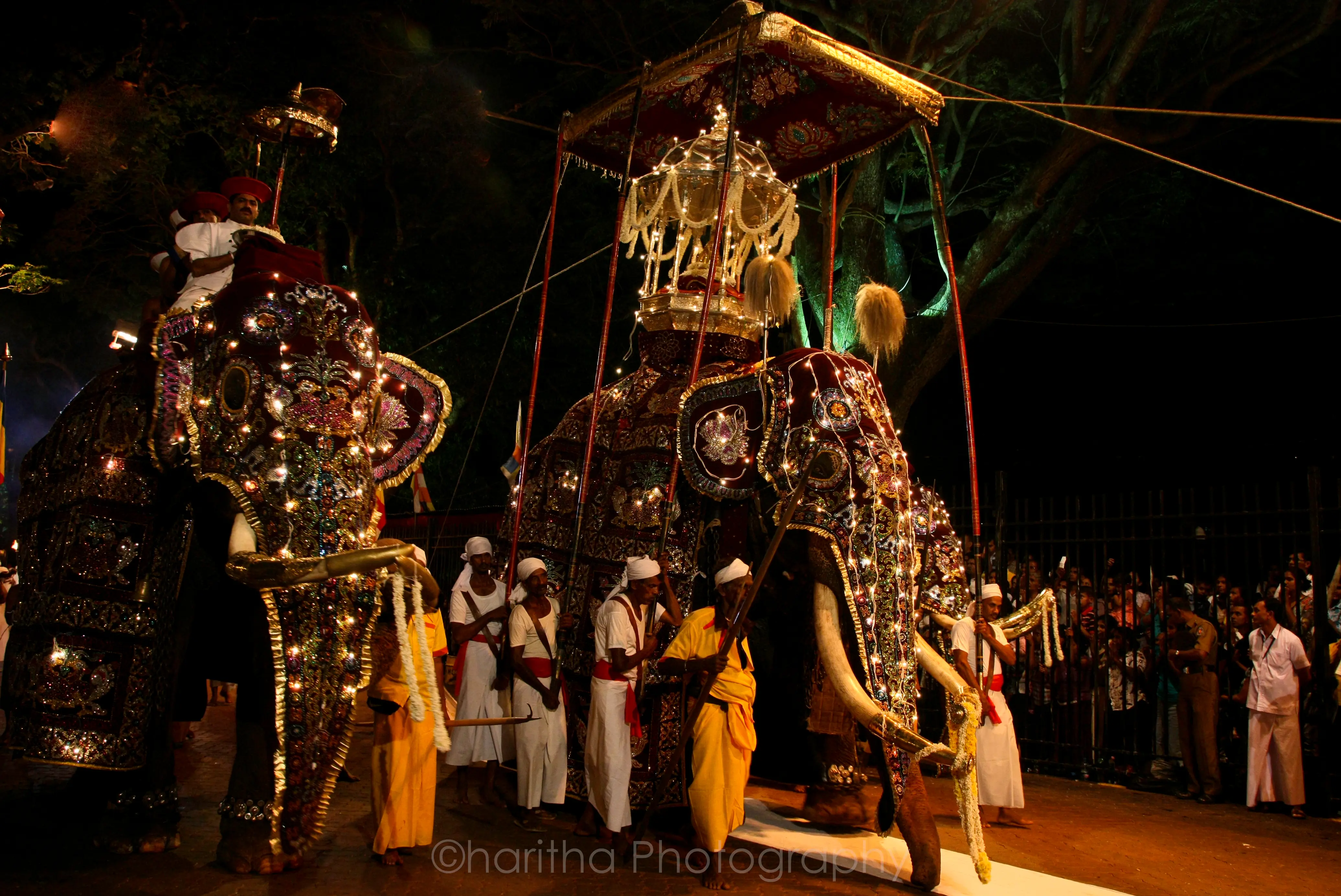
The principal tusker carries the casket beneath an elaborate canopy, surrounded by other elephants and ceremonial participants.
This is one of the most recognisable images of the Kandy Esala Perahera.
Sri Lanka Tourism notes the special importance of the principal tusker in the procession, while the Sri Dalada Maligawa describes the Sacred Tooth Relic as being venerated as the living Buddha.
The Elephants of the Kandy Perahera
The elephants are among the most visually striking elements of the procession.
Traditionally decorated with elaborate ceremonial coverings, they move slowly through the illuminated streets accompanied by drummers, dancers and other performers.
The elephants are not merely decorative attractions. They form part of the longstanding ceremonial tradition surrounding the procession.
The Sri Dalada Maligawa's 2026 reports, for example, documented elephants including Kataragama Wasana, Pulathisi and Sinharaja participating in the Randoli procession.
The Sound of Kandy: Drums and Traditional Music
Long before the procession comes into view, visitors can hear it.
The powerful sound of Kandyan drums, including traditional rhythmic performances, creates an atmosphere unlike an ordinary street festival.
Drummers and dancers move together as part of the procession, representing generations of Sri Lankan performing traditions.
For visitors interested in Sri Lankan culture, the Perahera provides an opportunity to see traditional music and dance performed in an authentic ceremonial setting.
Kandyan Dancers and Traditional Performers
The procession features numerous traditional performers.
Depending on the procession, visitors may see:
Kandyan dancers
Drummers
Flag bearers
Torch bearers
Traditional musicians
Whip crackers
Ceremonial officials
Dancers representing traditional artistic traditions
The colourful costumes, rhythmic movements and torchlight create one of the most memorable visual experiences in Sri Lanka.
The Four Devales of Kandy
The Kandy Esala Perahera incorporates four historic devales associated with important deities.
They are:
Natha Devale
Natha is traditionally regarded as a deity of special importance to Kandy and is associated with Buddhist traditions.
Vishnu Devale
Vishnu is traditionally regarded as one of Sri Lanka's guardian deities.
Kataragama Devale
Kataragama is associated with the deity of war and victory and has an important place in Sri Lankan religious traditions.
Pattini Devale
Pattini is traditionally associated with chastity, protection and healing.
The four devale processions maintain an established order within the larger Perahera.
The Water-Cutting Ceremony: Diya Kapeema
One of the most important rituals associated with the conclusion of the festival is the Diya Kapeema, or water-cutting ceremony.
Following the final night procession, the sacred casket is taken in an early-morning procession while the four Devale processions proceed towards the Mahaweli River at Gatambe.
The traditional water-cutting ceremony is then performed.
In 2026, this ceremony took place at the Mahaweli River in the early hours of 28 August, with thousands of devotees gathering along the riverbanks.
The ceremony was followed later that day by the traditional Day Perahera, bringing the year's festival to its conclusion.
A Living Tradition Connecting Sri Lanka's Communities
The Perahera is also remarkable because it brings together many different traditional roles and communities.
Religious custodians, dancers, drummers, craftsmen, elephant handlers, musicians, officials and local families all contribute to the continuation of the festival.
The Sri Dalada Maligawa has also documented traditional offerings connected with the festival, including an annual honey offering by Sri Lanka's Indigenous community during the 2026 Perahera. According to the Maligawa, this tradition is associated with the community's ancestral connection to the arrival of the Sacred Tooth Relic in Sri Lanka.
This demonstrates that the Perahera is much more than a single procession: it is a collection of traditions passed through generations.
Where Does the Kandy Perahera Take Place?
The festival takes place in and around the historic centre of Kandy.
The processions travel through important streets surrounding the Temple of the Sacred Tooth Relic and Kandy Lake.
For visitors, this means that the festival can be experienced alongside some of Kandy's most important attractions, including:
Sri Dalada Maligawa
Kandy Lake
Kandy City
Natha Devale
Vishnu Devale
Pattini Devale
Kataragama Devale
Traditional Kandyan cultural venues
Kandy's historic streets
Visiting Kandy During the Perahera
If you are planning a Sri Lanka trip around the Kandy Esala Perahera, it is important to plan ahead.
Kandy becomes exceptionally busy during the festival, especially during the final Randoli processions.
Book Accommodation Early
Hotels and guesthouses in Kandy and the surrounding areas can become heavily booked during the festival period.
Consider booking several months ahead if your travel dates are fixed.
Arrive Early
Popular viewing areas can become crowded long before the procession begins.
Travellers should allow additional time for road closures, traffic and pedestrian congestion.
Expect Road Closures
Special traffic and security arrangements are implemented during the Perahera.
For the 2026 festival, Sri Lanka Police introduced a real-time information system covering parking areas, procession routes, viewing locations, sanitary facilities and traffic information.
Bring Water
Kandy can be warm and crowded during the festival period. Carry drinking water and be prepared to spend several hours waiting and watching.
Respect the Religious Nature of the Event
Although the Perahera is visually spectacular, it is fundamentally a religious and cultural ceremony.
Visitors should:
Dress respectfully
Follow instructions from officials
Avoid obstructing the procession
Respect devotees and worshippers
Follow photography restrictions
Avoid inappropriate behaviour
Follow instructions around elephants and performers
What Should You Wear to the Kandy Perahera?
Sri Lanka is a culturally and religiously conservative country in many sacred settings.
For the Perahera, comfortable but respectful clothing is recommended.
If you are visiting the Temple of the Sacred Tooth Relic or another religious site, shoulders and knees should generally be appropriately covered.
Comfortable shoes are particularly useful because visitors may spend considerable time walking or standing.
Is the Kandy Perahera Suitable for Families?
Yes, families can enjoy the festival, particularly if children are interested in animals, music, costumes and cultural experiences.
However, the crowds can be very large.
Parents should keep children close, especially around busy streets and viewing areas.
It is also wise to plan breaks and avoid expecting young children to stand for several hours without rest.
Why International Travellers Should Experience the Kandy Perahera
For visitors coming to Sri Lanka from India, the United Kingdom, Europe, Australia, the United States, Canada, the UAE and other parts of Asia, the Kandy Esala Perahera offers something very different from a conventional sightseeing tour.
It provides an opportunity to experience:
Sri Lankan Buddhism + Kandyan culture + traditional dance + drumming + historic architecture + living religious traditions + spectacular night processions
Rather than simply visiting a museum and reading about Sri Lankan history, travellers can see traditional culture being practiced as part of a living festival.
Combine the Perahera with a Kandy Travel Experience
Kandy deserves more than one evening.
If you are visiting for the Perahera, consider spending several days exploring the surrounding region.
Visit the Temple of the Sacred Tooth Relic
Discover the spiritual heart of Kandy and learn about the history of the Sacred Tooth Relic.
Walk Around Kandy Lake
The lake provides a peaceful contrast to the busy streets of the city.
Explore the Royal Botanic Gardens
Located in Peradeniya, the gardens are among the most popular attractions around Kandy.
Visit the Ceylon Tea Museum
Learn about the history of Ceylon Tea and Sri Lanka's famous tea industry.
Discover Kandyan Arts and Dance
Experience traditional Kandyan dancing and drumming beyond the Perahera itself.
Explore the Three Temples
The historic temples of Embekke, Lankatilaka and Gadaladeniya provide an excellent cultural excursion from Kandy.
Explore the Mountains
Travellers can extend their Kandy journey towards the Knuckles Mountain Range, Hanthana, Nuwara Eliya or Ella.
Kandy Perahera and the Sri Lanka Travel Experience
A journey to Sri Lanka during the Kandy Esala Perahera can easily become part of a larger island adventure.
A sample itinerary could combine:
Colombo → Kandy → Sigiriya → Nuwara Eliya → Ella → Yala → Galle → South Coast
Or travellers looking for a more cultural journey could explore:
Kandy → Matale → Dambulla → Sigiriya → Polonnaruwa → Anuradhapura
Beach lovers could continue from Kandy towards:
Kandy → Nuwara Eliya → Ella → South Coast
The best route depends on the time of year, because Sri Lanka's two monsoon systems affect different parts of the island at different times.
Experience One of Sri Lanka's Greatest Cultural Festivals
The Kandy Esala Perahera is more than an extraordinary night-time spectacle.
It is a living expression of Sri Lankan Buddhist heritage, Kandyan culture, traditional music, dance, craftsmanship and religious devotion.
For centuries, generations of Sri Lankans have contributed to keeping these traditions alive.
As the drums begin, the streets illuminate, dancers move through the historic centre of Kandy and the ceremonial elephants slowly approach, visitors get a glimpse into a tradition that cannot be experienced in a museum or recreated for a performance.
If you are planning a Sri Lanka holiday during July or August, consider adding Kandy and the Esala Perahera to your itinerary.
Come to Kandy, discover the Sacred Tooth Relic, explore the mountains and tea country, and experience one of the most remarkable cultural celebrations in Sri Lanka.
Your journey into the heart of Sri Lankan culture begins in Kandy.
Frequently Asked Questions About the Kandy Esala Perahera
What is the Kandy Esala Perahera?
The Kandy Esala Perahera is an annual religious and cultural procession centred on the Sacred Tooth Relic of the Buddha and associated with the four historic Kandy devales.
When is the Kandy Perahera held?
It is generally held in July or August, according to the traditional lunar calendar. The exact dates change each year.
How long does the Kandy Perahera last?
The main festival traditionally develops over approximately ten days, culminating in the final Randoli procession and concluding rituals.
Is the Kandy Perahera held every year?
Yes. It is an annual festival, although the exact dates vary from year to year.
What is the Grand Randoli Perahera?
The Grand Randoli Perahera is the final and most elaborate night procession of the main festival sequence.
Can tourists watch the Kandy Perahera?
Yes. The festival attracts both Sri Lankan devotees and international visitors. However, visitors should remember that it is a religious ceremony and behave respectfully.
Are there elephants in the Kandy Perahera?
Elephants have traditionally formed an important part of the procession, including the principal tusker associated with carrying the ceremonial Sacred Relic Casket.
Where should I stay for the Kandy Perahera?
Staying in or around Kandy provides convenient access, but accommodation can become highly sought-after during the festival. Booking early is recommended.
What else can I do in Kandy?
You can visit the Temple of the Sacred Tooth Relic, Kandy Lake, Royal Botanic Gardens, Ceylon Tea Museum, traditional arts venues, the Three Temples and surrounding mountain and tea-growing areas.
Plan Your Kandy Perahera Experience
Planning to visit Sri Lanka for the Kandy Esala Perahera?
Tranquil Sri Lanka Tours can help you combine the festival with Kandy sightseeing, cultural experiences, tea country, wildlife safaris, Sigiriya, Ella, Nuwara Eliya and Sri Lanka's beautiful beaches.
Discover Kandy. Experience the Perahera. Explore Sri Lanka.