Blog
When Is the Best Time to Visit Sri Lanka: Complete Month by Month Weather Guide
7 Oct 2026 · 5 min read
When Is the Best Time to Visit Sri Lanka: Complete Month by Month Weather Guide
•5 min read•Blog
The Best Time to Visit Sri Lanka: A Month-by-Month Weather Guide
Sri Lanka is a small island with a surprisingly complex climate. Because of two monsoon systems, the west and south coasts can be sunny while the east coast is soaked, and a few weeks later the situation reverses. This means there is no single "best" month for the whole island. The best time depends on where you want to go and what you want to do.
Sri Lanka's Climate at a Glance
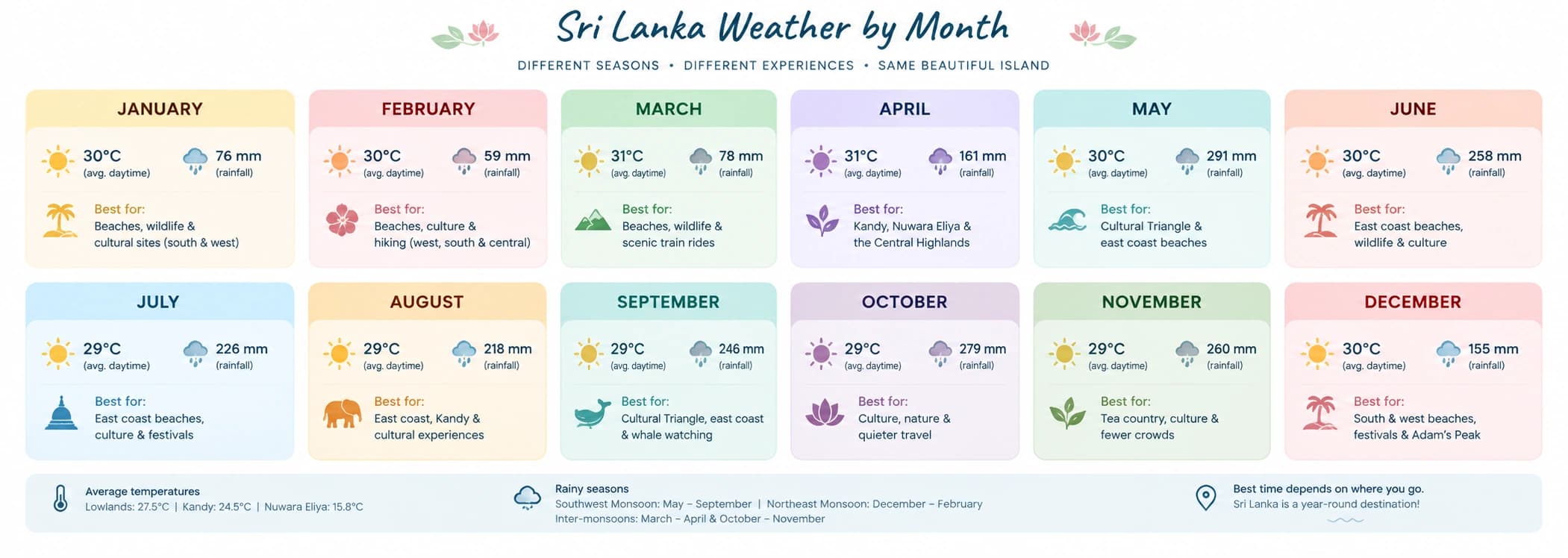
Sri Lanka lies close to the equator, so temperatures stay warm all year. Lowland areas average about 27.5°C, and the difference between the coolest and warmest months is only around 2 to 3°C. What changes is the rain, and it follows four seasons:
South-west (Yala) monsoon, May to September: Heavy rain on the south-west coast and the Hill Country.
First inter-monsoon, March to April: Mostly hot, with occasional afternoon thunderstorms.
Second inter-monsoon, October to November: Usually the rainiest period island-wide.
North-east (Maha) monsoon, December to February: Rain mainly on the east and north-east.
Elevation also matters. Temperature drops about 6.5°C for every 1,000 metres you climb. Kandy averages around 24.5°C, while Nuwara Eliya, at nearly 1,900 metres, averages about 15.8°C and can have cold early mornings. Pack a jacket if you're heading to tea country.
The Quick Answer
If you want... Go in...
Beaches on the south and west coast December to March
Beaches on the east coast (Trincomalee, Passikudah) May to September
Cultural Triangle and Sigiriya Year-round (driest January to September)
Hill Country and tea estates January to April
Wildlife and safaris February to July
Fewer crowds and lower prices April to May, late October to November
Month-by-Month Breakdown
January: Sunny and Perfect
Dry and warm (around 30°C) along the south and west coasts and in the central regions. It's a great month for beaches in Mirissa and Galle and for safaris in Udawalawe and Minneriya, where animals gather around dwindling water sources. The east coast still sees some leftover monsoon rain.
February: Peak Season
Excellent weather across the west, south and centre, with temperatures climbing past 30°C. It's popular, so expect crowds at Sigiriya and Galle Fort. To avoid them, visit quieter spots such as Mihintale or the north-east. National Independence Day is on 4 February.
March: One of the Best Months
The north-east monsoon is nearly over, the beaches are sunny, and temperatures reach the mid-30s. School holidays have ended in many countries, so crowds are thinner. Occasional thunderstorms can appear late in the month.
April: Hot, Then Humid
Great for the Hill Country, with comfortable temperatures and below-average rain. Colombo, Kandy and the Cultural Triangle get muggy, so head to higher ground if the heat bothers you. This is also a good month for trekking Horton Plains or climbing Adam's Peak. The Sinhalese and Tamil New Year in mid-April is the island's biggest family festival.
May: The Monsoon Arrives
The south-west monsoon reaches the west, south and central regions. Rain tends to be short and heavy, with sunny breaks in between. Sea swimming on the south and west coasts can be dangerous due to large waves. The east coast comes into its own, and the Vesak Poya festival of lights is a beautiful time to be in the country.
June: Head East
The south-west monsoon continues, bringing rain and cooler weather to the Hill Country. The east coast is sunny with low-30s temperatures, making it ideal for Trincomalee and Passikudah. Pair a Cultural Triangle trip with a few days at a beach resort in the east.
July: Warm East, Wet South-West
Much like June. Resorts such as Negombo, Bentota and Weligama are affected by the monsoon, while the east coast is warm and sunny. It's a good time for whale watching, snorkelling and other water activities on the east side. Kandy's Esala Perahera, a grand procession with dancers, drummers and elephants, takes place in July or August.
August: A Hidden Gem
Rain in the south and west drops significantly, and the east coast stays pleasant. This is a good family holiday month, and the Perahera festivities in Kandy are in full swing. Jaffna's Nallur Kandaswamy Temple Festival is a highlight for culture lovers.
September: The Transition
The south-west monsoon is easing, but rough seas can still make swimming unsafe on some coasts. The east coast's good weather is ending, with rain increasing late in the month. The Cultural Triangle remains dry and sunny. Trincomalee offers blue whale sightings.
October: The Wettest Month
Inter-monsoonal rain and thunderstorms affect most of the island. The Cultural Triangle stays relatively dry and hot. The upside is low season: fewer tourists, cheaper accommodation and the Diwali celebrations in late October or early November, especially in the north and east.
November: A Good Time to Visit
Rain gradually eases from the south-west, though the Cultural Triangle, hills and north-east can still get showers. Travelling in the last week of the month lets you enjoy improving weather before peak-season crowds and prices arrive. It's a good month for tea factory visits and pottery workshops.
December: Peak Season Begins
Dry, pleasant weather returns to Colombo, Kandy and the southern beaches, including Unawatuna and Mirissa. Book accommodation and tours well in advance. The north-east monsoon is still active, so places such as Jaffna and the north-east are better saved for another time. December is also the start of the Adam's Peak pilgrimage season.
Sri Lanka Geography: Why the Weather Varies So Much
Sri Lanka covers about 65,610 km², is roughly 432 km long and 224 km wide, and has a coastline of around 1,790 km. Its pear-like shape includes a mountainous south-central region surrounded by plains. The highest peak, Piduruthalagala, reaches 2,524 metres. These mountains act as a barrier that splits the island's weather: monsoon winds drop their rain on one side while the other stays dry.
Rainfall varies enormously, from under 1,000 mm in the arid parts of the north-west and south-east to over 5,000 mm in the hills of Kegalle and Nuwara Eliya. The country also has around 103 river basins and more than 50 recorded waterfalls, with Bambarakanda the tallest at 241 metres.
Final Tips for Planning Your Trip
Combine regions by season. For example, in December to March, pair the Cultural Triangle, Hill Country and the south coast. In May to September, pair the Cultural Triangle with the east coast.
Watch the sea. During monsoon months, ocean currents can be dangerous. Follow local advice and lifeguard flags.
Book early for December to February. Popular hotels and train tickets, especially the scenic Kandy to Ella route, sell out quickly.
Pack for variety. Lightweight clothing, a rain jacket and a warm layer for the hills will cover almost any itinerary.
Check conditions before you go. Weather patterns can shift, so look at the latest forecasts and any local advisories close to your travel dates.
Conclusion
If you only want the simplest answer, December to March is the most reliable window for the classic Sri Lanka trip of culture, hills and southern beaches. But thanks to the island's two monsoons, there's always somewhere with good weather. Choose your month, then choose your coast.
When Is the Best Time to Visit Sri Lanka?
The best time to visit Sri Lanka depends on where you want to go. Unlike countries with one clear summer and winter travel season, Sri Lanka has two main monsoon systems and two shorter inter-monsoon periods. This means that while one side of the island may be experiencing rain, another region can be sunny, warm and perfect for a beach holiday.
So, there is really no single bad month to visit Sri Lanka. The key is choosing the right destinations for the season.
From tropical beaches and ancient cities to misty mountains, tea plantations, wildlife parks and cultural experiences, Sri Lanka can be explored throughout the year if your itinerary is planned around the weather.
Understanding Sri Lanka's Climate
Sri Lanka is a tropical island, and temperatures remain relatively warm throughout the year. Lowland areas have an average annual temperature of around 27.5°C, while the Central Highlands are considerably cooler. Kandy averages around 24.5°C, while Nuwara Eliya has an average annual temperature of about 15.8°C.
The island's weather is mainly influenced by four rainfall periods:
Southwest Monsoon: May to September
October–November Inter-monsoon: generally the wettest period
Northeast Monsoon: December to February
March–April Inter-monsoon: generally lighter rainfall than October–November
Rainfall also varies greatly from region to region. The southwest and central hills receive considerably more rain than some of the drier parts of the north and southeast.
This is why a weather forecast for "Sri Lanka" does not always tell the whole story.
Sri Lanka in January
Best for: Beaches, wildlife, cultural sightseeing and the south and west
January is one of the most popular times to travel around Sri Lanka. The south and west coasts, Cultural Triangle and many inland destinations generally offer warm and relatively dry conditions.
It is a particularly good month for combining cultural sightseeing with a beach holiday. You could explore Sigiriya and Polonnaruwa before continuing towards beaches such as Bentota, Mirissa or the southern coast.
Wildlife experiences can also be excellent, with national parks offering opportunities to see elephants and other Sri Lankan wildlife.
The northeast, however, can still be affected by the Northeast Monsoon, so travelers planning to visit the east and northeast should take local weather conditions into account.
Ideal itinerary: Cultural Triangle → Kandy → South Coast
Sri Lanka in February
Best for: Exploring the Cultural Triangle, beaches, hiking and cultural experiences
February is generally one of the more reliable months for traveling around many parts of Sri Lanka. The west, south and central regions can experience plenty of sunshine, with temperatures often reaching around 30°C or higher in the lowlands.
The Central Highlands are cooler, making this a comfortable time to combine cultural sightseeing with mountain scenery.
February is also an important month for Sri Lanka's national celebrations, with Independence Day celebrated on 4 February.
Popular attractions can become busy during this period, so travelers who prefer quieter experiences may want to include lesser-visited areas and allow extra time at major attractions such as Sigiriya and Galle Fort.
Ideal itinerary: Cultural Triangle → Kandy → Ella → Southern Coast
Sri Lanka in March
Best for: A classic Sri Lanka holiday
March is often one of the best all-round months for visiting Sri Lanka.
The Northeast Monsoon is coming to an end, while the south and west generally enjoy warm, sunny conditions. Temperatures on the southern and western coast can reach the mid-30s°C.
It is an excellent month for combining several different experiences:
Ancient cities
Wildlife safaris
Tea country
Scenic train journeys
Hiking
Beaches
Local culture
March can also be attractive for travelers who want good weather without the busiest family-travel periods. However, Sri Lankan weather can still be unpredictable, and short rain showers or thunderstorms are always possible.
Ideal itinerary: Sigiriya → Kandy → Ella → Yala → South Coast
Sri Lanka in April
Best for: Kandy, Nuwara Eliya, the Central Highlands and cultural experiences
April is another attractive month, particularly during the first part of the month.
The west and south are approaching the end of their drier season, so humidity can increase, particularly around the Cultural Triangle. Meanwhile, the Central Highlands can be particularly pleasant.
Kandy and Nuwara Eliya offer cooler temperatures compared with the tropical coast, making April a good time to experience Sri Lanka's mountains, tea plantations and scenic landscapes.
April is also a special cultural month because the Sinhala and Tamil New Year takes place in mid-April, bringing traditional celebrations, food, games and family activities across the country.
For travelers interested in walking and hiking, the Central Highlands can be particularly rewarding.
Ideal itinerary: Kandy → Nuwara Eliya → Horton Plains → Ella
Sri Lanka in May
Best for: The Cultural Triangle and starting an east-coast beach holiday
May marks an important seasonal change.
The Southwest Monsoon begins affecting the south, west and central regions, while the eastern side of Sri Lanka increasingly becomes the better choice for sunshine and beach experiences.
Rain in the southwest can sometimes arrive as short, intense showers followed by periods of sunshine. However, sea conditions can become rough, and swimming on some southern and western beaches may not always be advisable.
This is therefore a good month to think regionally rather than avoid Sri Lanka altogether.
Travelers can explore the Cultural Triangle and then move towards the east coast.
Ideal itinerary: Sigiriya → Polonnaruwa → Trincomalee or Pasikuda
May is also an important Buddhist month because Vesak, the Full Moon festival, is celebrated with lanterns, decorations and religious activities.
Sri Lanka in June
Best for: East-coast beaches, wildlife and the Cultural Triangle
June is firmly within the Southwest Monsoon period.
The southern and western parts of the island can experience more rain, while the east coast becomes one of the best places for a tropical beach holiday.
Trincomalee and Pasikuda are excellent choices for travelers looking for warm weather, beaches and the Indian Ocean.
The Cultural Triangle can also remain relatively hot and dry compared with the southwest.
This makes June an excellent month for combining ancient Sri Lankan history with an east-coast beach stay.
Ideal itinerary: Kandy → Sigiriya → Polonnaruwa → Trincomalee
Sri Lanka in July
Best for: East-coast beaches, marine activities, culture and festivals
July is similar to June.
The southwest remains influenced by the monsoon, while the north and east can enjoy warm and sunny weather, with temperatures around the low 30s°C in many areas.
This is a particularly good time for:
Trincomalee
Pasikuda
Batticaloa
Cultural Triangle
Swimming and snorkeling
Marine experiences
Cultural festivals
Sri Lanka's famous Kandy Esala Perahera may take place in July or August, depending on the lunar calendar. This spectacular cultural celebration features traditional dancers, drummers, processions and religious ceremonies.
Ideal itinerary: Cultural Triangle → Kandy → East Coast
Sri Lanka in August
Best for: East-coast beaches, Kandy and cultural festivals
August can be an excellent month for a Sri Lankan holiday, particularly for travelers visiting during the European and Australian summer holidays.
Rainfall in parts of the south and west can decrease compared with the preceding months, while the east remains a strong choice for beach travel.
August is also an exciting time for cultural travelers.
If the dates coincide, visitors can experience the Kandy Esala Perahera, one of Sri Lanka's most famous traditional festivals.
The north can also be fascinating at this time, particularly for travelers interested in Tamil culture, history and local festivals.
Ideal itinerary: Kandy → Cultural Triangle → Trincomalee
Sri Lanka in September
Best for: The Cultural Triangle, east-coast travel and quieter experiences
September is a transitional month.
The east coast begins moving away from its best weather period, while rainfall can increase towards the latter part of the month. The south, west and Central Highlands can also experience changing weather conditions.
The Cultural Triangle can remain relatively warm and dry, making destinations such as Sigiriya and Polonnaruwa attractive options.
Because weather conditions can be less predictable, September is better suited to travelers who are flexible with their itinerary rather than those looking for guaranteed beach weather.
Ideal itinerary: Cultural Triangle → Kandy → Ella, with flexible planning
Sri Lanka in October
Best for: Cultural experiences, lower-season travel and travelers who don't mind rain
October is generally one of the wettest months of the year because of the inter-monsoon period and the beginning of the Northeast Monsoon.
Rain and thunderstorms can occur across many parts of the island, although conditions can vary considerably from one location to another.
The advantage is that October is part of the lower travel season. Popular attractions can be quieter, and accommodation may offer better value.
For travelers who don't mind changing their plans around showers, October can still offer rewarding experiences.
It is also a time when festivals such as Diwali may bring vibrant celebrations, particularly in areas with significant Hindu communities.
Ideal itinerary: Flexible cultural and nature itinerary
Sri Lanka in November
Best for: Avoiding peak crowds and experiencing Sri Lankan culture
November is another transitional month.
Weather conditions begin to improve in some parts of the island as the Southwest Monsoon decreases, but the Cultural Triangle, mountains, north and east can experience increased rainfall.
For travelers who want to avoid the crowds of December while still having the possibility of improving weather, late November can be an attractive option.
It can also be a good month for travelers interested in:
Tea plantations
Local markets
Traditional crafts
Monasteries
Rural experiences
Cultural sightseeing
Ideal itinerary: Kandy → Tea Country → Cultural Triangle → South Coast, depending on conditions
Sri Lanka in December
Best for: Beaches, Christmas holidays, the south and west, and Adam's Peak
December marks the beginning of Sri Lanka's popular high season.
The south and west coasts and many major tourist destinations can enjoy pleasant, relatively dry conditions. Beach destinations such as Mirissa, Unawatuna and other southern resorts become particularly popular.
The Central Highlands and destinations such as Kandy can also be attractive.
December is a popular travel month, especially around Christmas and New Year, so accommodation, drivers and popular activities should be booked well in advance.
For adventurous travelers, the pilgrimage season at Adam's Peak is another reason to visit during this period.
The northeast, however, can still be influenced by the Northeast Monsoon.
Ideal itinerary: Colombo/Negombo → Cultural Triangle → Kandy → Ella → South Coast
So, When Is the Best Time to Visit Sri Lanka?
The simple answer is:
December to April – Best for the South, West and Central Sri Lanka
If your dream Sri Lanka holiday includes:
Mirissa
Galle
Bentota
Weligama
Yala
Udawalawe
Kandy
Nuwara Eliya
Ella
Sigiriya
Dambulla
Polonnaruwa
then December to April is generally a very good period to consider.
Among these months, January, February and March can offer particularly favorable conditions for a classic Sri Lanka itinerary.
May to September – Best for the East and North
If you want to enjoy:
Trincomalee
Nilaveli
Pasikuda
Batticaloa
Jaffna
East-coast beaches
Snorkeling
Swimming
Marine experiences
then May to September can be an excellent period to consider, particularly from June through August.
This is one of the biggest advantages of traveling in Sri Lanka: you can often move to the opposite side of the island to find better weather.
What About October and November?
October and November are more unpredictable because of the inter-monsoon period.
They can bring widespread rain and thunderstorms, but this doesn't mean you should completely avoid Sri Lanka.
These months can suit travelers who:
Prefer fewer tourists
Want better-value accommodation
Are flexible with their itinerary
Enjoy cultural experiences
Don't mind occasional tropical rain
Want to explore Sri Lanka at a quieter pace
Sri Lanka's October–November period is generally the rainiest period when considering the island as a whole.
The Best Time for Different Types of Sri Lanka Holidays
Best for Southern & Western Beaches
December – April
Mirissa, Weligama, Bentota, Unawatuna, Galle and other southern and western coastal destinations are generally most suitable during this period.
Best for East Coast Beaches
May – September
Trincomalee, Nilaveli, Pasikuda and nearby areas are excellent alternatives when the southwest is experiencing its monsoon.
Best for Wildlife
Wildlife can be enjoyed throughout the year, but the best park and safari experience depends on the location and seasonal conditions.
Best for the Hill Country
January – April can offer comfortable conditions, although the mountains have their own microclimates and rain is possible throughout the year.
Best for the Cultural Triangle
The Cultural Triangle can be visited throughout the year. January–April can be particularly attractive, while the region can also work well in the southwest monsoon months.
Best for Hiking
January – April can be excellent for many highland experiences, although conditions vary by trail and elevation.
Best for Marine Experiences
The best location depends on the season. The east coast becomes particularly attractive during the southwest monsoon months.
🎉 Best for Festivals
Sri Lanka has cultural and religious celebrations throughout the year, including Independence Day, Sinhala and Tamil New Year, Vesak, Poson and the Kandy Esala Perahera.
Does It Rain All Day During the Monsoon?
Not necessarily.
Sri Lanka's tropical rainfall can be very different from the prolonged rain many travelers imagine when they hear the word "monsoon".
Some periods can bring heavy showers followed by sunshine. Inter-monsoon periods can also produce afternoon or evening thunderstorms.
Rainfall is affected by geography, altitude, monsoon winds and local weather systems, so conditions can vary significantly even between nearby destinations.
This is why an experienced local travel planner can make a significant difference when designing a Sri Lanka itinerary.
Sri Lanka Is a Year-Round Destination
One of the biggest mistakes travelers make is asking:
"What is the best month to visit Sri Lanka?"
A better question is:
"Which part of Sri Lanka should I visit during the month I am traveling?"
Sri Lanka is a relatively small island, but its mountains, coastlines, dry zones, wet zones and changing monsoon systems create remarkably different conditions across the country.
You might wake up among misty tea plantations in the Central Highlands, travel through a dry-zone landscape around the Cultural Triangle and finish the day beside a sunny tropical beach.
That is what makes Sri Lanka special.
Planning Your Sri Lanka Holiday
Whether you are dreaming of a beach holiday, wildlife safari, cultural journey, scenic train ride, hiking adventure, surfing trip or a complete island tour, the right itinerary can be designed around the season.
At Tranquil Sri Lanka Tours, we believe the best Sri Lanka holiday isn't simply about choosing the "perfect month." It is about choosing the right places, experiences and route for the month you are traveling.
If you tell us when you are planning to visit Sri Lanka, how many days you have and what you would most like to experience, we can help you build a journey around the season.